
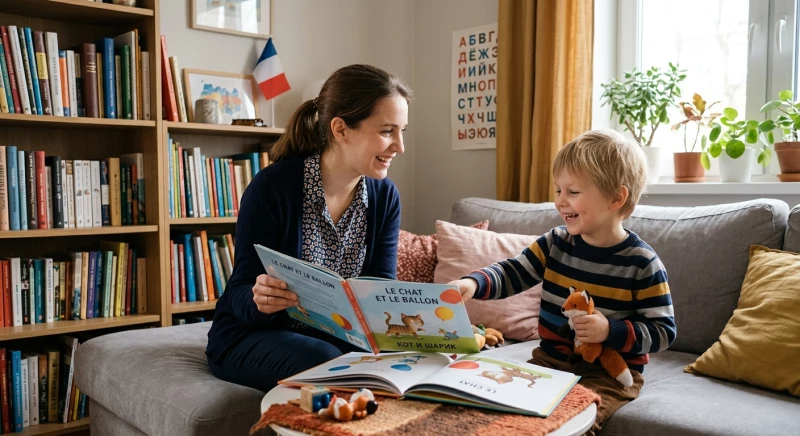
Parents planning an international education for their child rarely stop at two language lessons a week. A second language becomes truly reliable only when a child lives in it. This is exactly what a bilingual governess creates: a natural language environment inside the family home, where the language is not a subject on the timetable but simply the way the day is spoken.
Why a Language Learned at Home Works Differently
A school lesson teaches a child about a language. A bilingual governess teaches the child to live in it. Vocabulary is acquired in context — while setting the table, building a Lego city, or discussing a rainy afternoon — so words are stored together with situations and emotions rather than as translation pairs. This is why children raised in such an environment rarely translate in their heads: they simply switch.
The Right Age to Start
Ages 3–6: absorbing
The most forgiving period. A child copies intonation and pronunciation effortlessly and without fear of making mistakes. At this age the governess does not "teach" — she plays, sings, reads, and comments on everything that happens, and the language settles in on its own.
Ages 7–10: structuring
Speech is joined by reading and writing. Grammar appears as a system, and the second language begins to carry content: science, geography, history. This is the stage at which a child is prepared for entry into an international school.
Ages 11 and older: academic language
The focus shifts to essays, presentations, discussion, and exam formats — Cambridge, IELTS, school entrance assessments. Here the governess works as an academic tutor while maintaining the everyday, living layer of the language.
The "One Adult — One Language" Principle
The most effective model in a bilingual household is strict consistency: one adult always speaks one language. The child mentally links the language to the person and switches automatically, without being asked. As soon as the governess starts mixing languages "to make things easier", the mechanism breaks down and the child stops making the effort to understand — because a translation is always coming.
What a Day with a Bilingual Governess Looks Like
morning routine and breakfast entirely in the target language;
20–40 minutes of a structured lesson, adjusted to age and attention span;
reading aloud with discussion rather than mechanical retelling;
games, crafts, and cooking used as live vocabulary practice;
homework support, including subjects taught at school;
a walk with running commentary on everything around — the simplest and most underrated exercise;
an evening story and a short conversation about how the day went.
In total this gives four to six hours of daily immersion — more than any course can offer, and without the child ever feeling that they are being taught.
Five Mistakes Parents Make
Expecting fast results. Many children go through a silent period: they understand everything but do not speak for weeks or even months. This is a normal stage of accumulation, not a failure of the specialist.
Correcting every mistake. Constant correction is the fastest way to make a child stop speaking. A professional simply reformulates the phrase correctly in her reply instead of interrupting.
Changing specialists often. A child bonds with a person, not with a language. Every change restarts the emotional contact and, with it, the willingness to speak.
Turning the language into a reward or a punishment. "No cartoons until you say it in English" reliably converts the language into a source of tension.
Pausing the second language during a difficult school period. It takes a few weeks to lose fluency and many months to bring it back.
Native Speaker or Certified Teacher?
A native speaker gives authentic pronunciation, living idiom, and cultural context. A qualified teacher gives structure, diagnostics, and the ability to explain why something works the way it does. For preschool children the environment matters most; from school age onwards, methodology and exam experience become decisive. The strongest option is a specialist who combines both — a native or near-native speaker with a pedagogical background and experience in private families.
How to Tell That It Is Working
the child answers in the second language without being asked to;
they talk to themselves or to their toys in it while playing;
they ask what a single word means instead of demanding a translation of the whole sentence;
they understand and make jokes in the language — the clearest sign of real fluency;
they switch between languages depending on who is in the room, without pausing.
Why Selection Through an Agency Matters
Choosing a bilingual governess is not a standard recruitment task. It requires verifying not only the language level, but also teaching qualifications, references from previous families, and the ability to work within a private household. Royal Keeper conducts professional, psychological, and background screening for every candidate, which is essential for a family's privacy and security.
The agency's international expertise allows us to place bilingual governesses in Europe, the UAE, and the USA, taking into account visa requirements, local legislation, and cultural specifics. Selection is based on the real needs of a particular child — age, temperament, current level, and educational goals — rather than on formal criteria.
Frequently Asked Questions (FAQ)
Will two languages confuse the child or delay their speech?
No. Mixing languages within one sentence is a normal and temporary stage: the child uses whichever word comes faster. It resolves on its own, usually by the age of four or five, as the two systems separate.
Does the child need to know the language before starting?
No. A bilingual governess can start from zero — with young children this is even easier, because there is no habit of translating yet.
What language should be spoken when the parents are in the room?
The governess keeps to her language even in the parents' presence. Consistency matters more than the comfort of the adults, and children adapt to it within days.
How many hours a week are needed for a real result?
Full-time formats work best, but consistent contact of fifteen to twenty hours a week already produces stable progress — provided it does not stop during holidays and school breaks.