
A family's household staff know more about its daily life than most relatives do. They see the calendar, the guests, the children's routines, the state of health, the tensions, the deliveries, the documents left on a desk. In a high-profile household this information has value — commercial, reputational, and sometimes physical. And yet the majority of breaches are not betrayals: they are a photo posted without thinking, a name mentioned to a friend, an address given to a courier who asked twice.
What Household Staff Actually See
Before writing any rules, it helps to be honest about the surface area. A nanny knows the children's schools, routes, and schedules. A housekeeper sees correspondence, medication, purchases, and who stays overnight. A driver knows every address the family visits and how often. A personal assistant handles bookings, documents, and payments. Any one of these fragments is harmless; assembled, they are a full picture of a family's life.
What an NDA Does — and What It Does Not
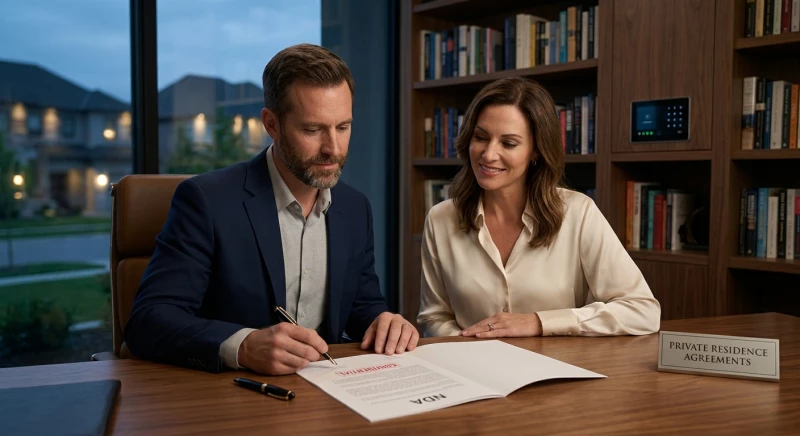
A non-disclosure agreement does three useful things. It defines precisely what counts as confidential, so "I did not think that was private" stops being a defence. It sets out consequences, which changes behaviour more reliably than goodwill does. And it puts the subject on the table at the moment of hiring, which is when expectations are cheapest to set.
What it does not do is turn discretion into a solved problem. An NDA does not prevent a leak; it gives you recourse afterwards, and enforcement takes time and usually makes a matter more public rather than less. Its scope and enforceability differ substantially between jurisdictions, and clauses that are standard in one country may be unenforceable in another. It also cannot — and should not — prevent an employee from reporting a crime, cooperating with authorities, or seeking legal advice. This article is general information rather than legal advice: have the document drafted or reviewed by a lawyer in the country where the employee will actually work.
What a Household Confidentiality Agreement Usually Covers
a clear definition of confidential information: family members and their names, addresses and routes, schedules, guests, health, finances, business matters, photographs and video;
a ban on publishing anything related to the family on social media, including background details visible in the employee's own photographs;
rules on photography and filming inside the home, and on the children in particular;
who the employee may and may not discuss work with, including their own family and friends;
the handling of devices, keys, access codes, and documents;
the duration of the obligation, which normally continues after the contract ends;
consequences of a breach, and the procedure if one occurs;
an explicit carve-out for lawful reporting and cooperation with authorities.
House Rules That Work Better Than Paperwork
Most of the privacy in a private home is maintained by habits rather than by clauses. The rules worth writing down and explaining on day one:
No photographs of the children, the interiors, or the family — ever, including "just for myself". This single rule prevents most incidents.
Phones stay out of working areas during working hours, with an agreed way for the employee to be reached in an emergency.
Nobody is told who lives here. Couriers, contractors, neighbours, and school parents get a neutral answer, not a name.
Staff do not bring guests into the home, and do not share the address, gate codes, or the family's schedule with anyone.
Work is not discussed outside the house — not with friends, not in professional chat groups, not with the staff of neighbouring households.
Documents, mail, and screens are not read; anything found lying around is handed over, not examined.
Rules that are explained tend to be followed; rules that are merely imposed tend to be worked around. Say plainly why each one exists — the safety of the children, not distrust of the employee.
Digital Hygiene
Give staff a guest network rather than the family's Wi-Fi, and their own limited accounts in any smart-home system. Do not share the family's passwords; where shared access is genuinely needed, use a password manager with individual logins that can be revoked in a minute. Keep cameras out of private areas — bedrooms, bathrooms, and staff accommodation — and tell employees in writing where cameras exist, since in many countries covert recording of workers is unlawful. When someone leaves, revoke access the same day: codes, keys, accounts, shared calendars, delivery app permissions.
What to Check Before Hiring
identity documents and the right to work;
a criminal record check;
direct conversations with previous employers — not only a written reference, but a call, with attention to how the person talks about the family they used to work for;
a review of the candidate's public social media, looking at how they present previous jobs;
a psychological assessment for positions with close access to the children.
The strongest predictor of discretion is how a candidate speaks about their last employer at the interview. Someone who names the family, describes the house, or shares a story about the children will do the same about you.
If a Breach Happens
Establish the facts before reacting: what exactly was disclosed, to whom, and how. Ask for the material to be removed and secure evidence of the breach. Restrict access while the situation is being clarified. Take legal advice before threatening consequences — an overreaction can amplify precisely the exposure you are trying to contain. Afterwards, look at the process and not only at the person: most breaches reveal a rule that was never explained, or an access right that should have been revoked months earlier.
Where an Agency Helps
Confidentiality is easier to protect when it is verified before hiring rather than repaired afterwards. Royal Keeper conducts professional, psychological, and background screening for every candidate and works with families in Europe, the UAE, and the USA, taking local employment law and the required documents of each jurisdiction into account. Discretion here is a working standard rather than a clause: candidate details, family requirements, and the fact of the search itself are treated as private throughout.
Frequently Asked Questions (FAQ)
Is an NDA legally binding for domestic staff?
In most jurisdictions a confidentiality clause in an employment contract is enforceable, but the details — scope, duration, permitted exceptions, and penalties — vary widely by country. Have it drafted locally rather than copied from a template found online.
Can we ban phones entirely?
You can restrict phone use during working hours in defined areas, and this is common practice. A blanket ban is usually neither lawful nor workable; agree instead on break times and an emergency contact route.
Should the obligation continue after the contract ends?
Yes. Confidentiality obligations normally survive termination — that is the point of them. The specific duration should be set with a lawyer.
What about the family's other contractors?
The same principle applies. Renovation teams, tutors, trainers, and event staff should be covered by their own confidentiality terms; a household is only as private as its least-briefed visitor.